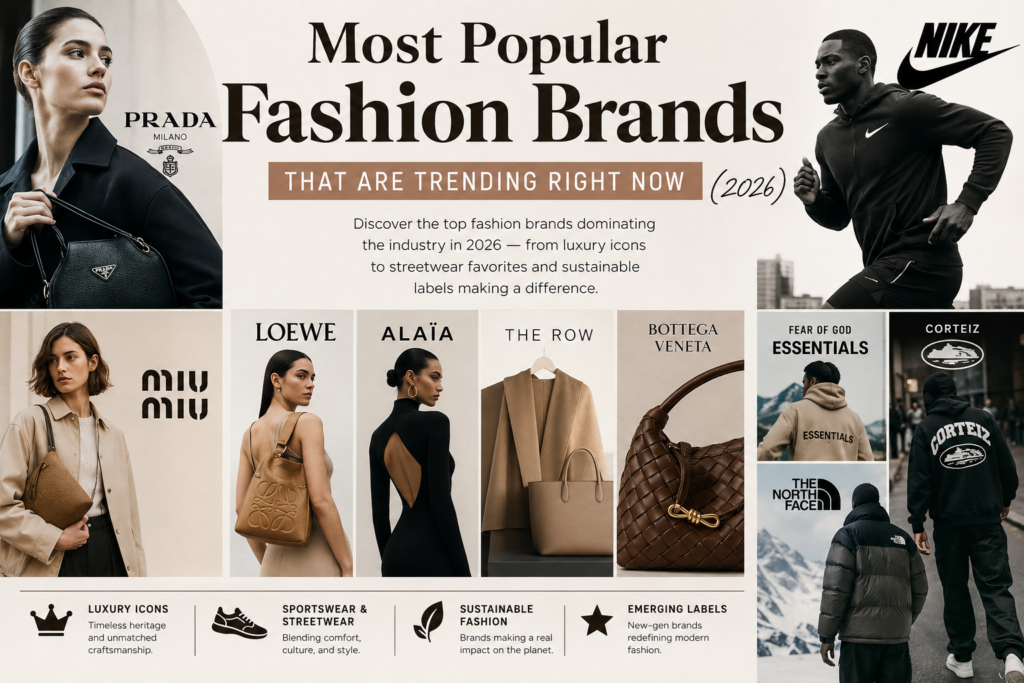
Fashion in 2026 looks different from the fashion of even two or three years ago. The old formula — spend big on advertising, plaster a logo everywhere, and wait for sales to follow — no longer guarantees relevance. Today’s most talked-about brands earn their spot through cultural relevance, community, craftsmanship, and a story people actually want to be part of. Whether it’s a century-old luxury house or a two-year-old streetwear label started in a bedroom, the brands winning attention right now share one thing: they feel meaningful, not just visible.
Here’s a look at the brands genuinely dominating conversations, closets, and search trends this year — across luxury, sportswear, streetwear, sustainable fashion, and the emerging names about to break into the mainstream.
1. Luxury Houses Still Setting the Tone
Luxury fashion hasn’t lost its grip on culture — it’s just gotten smarter about how it holds onto it.
Prada remains one of the most influential names in fashion, and its position isn’t just about heritage. Under Miuccia Prada’s continued creative direction, the brand blends intellectual minimalism with bursts of avant-garde experimentation, giving it a rare balance of prestige and freshness. Its Cleo bag, sneakers, and Galleria bag continue to be some of the most recognized status pieces in the world.
Miu Miu, Prada’s playful sister label, has actually reclaimed the top spot in several industry demand indexes this year, proving that irreverence and youthful energy can outperform even the most established heritage houses when it comes to online buzz and search demand.
Loewe is arguably the “it” brand for the fashion elite right now. Under creative direction that leans into surrealism — think designs that mimic pixel art or organic, nature-inspired silhouettes — Loewe has carved out a lane that feels both intellectually interesting and instantly Instagrammable. Its leather craftsmanship is considered some of the best in the industry, which keeps it credible with old-school luxury purists while its weirder design choices keep it relevant with younger, trend-driven shoppers.
Alaïa, under Pieter Mulier, has also surged dramatically this year — some indexes show it climbing more than a dozen spots in a single quarter. Its appeal lies in sculptural, body-conscious design that doesn’t chase seasonal trends, appealing to shoppers who want something that feels permanent rather than disposable.
Then there’s The Row — a brand that has become almost a case study in how not advertising can be the most powerful marketing strategy of all. With no logos, no social media presence, and virtually no traditional advertising, The Row has built one of the most desired “quiet luxury” wardrobes purely through word of mouth and its reputation for exceptional, understated craftsmanship. Meanwhile, Bottega Veneta has leaned into longevity as a selling point, introducing a lifetime guarantee on its bags to signal that its pieces are investments, not disposable trend items.
2. Sportswear and Streetwear: Comfort Meets Culture
Sportswear giants haven’t gone anywhere — they’ve just evolved.
Nike remains the undisputed leader in performance and street-style crossover fashion. This year, the brand has doubled down on circular fashion initiatives and AI-driven personalization, all while maintaining a sneaker catalog that continues to define entire generations of style. Its collaboration strategy — bridging elite athletic performance with everyday streetwear — keeps it relevant across wildly different audiences.
Fear of God Essentials, Jerry Lorenzo’s minimalist, earth-toned loungewear line, has become something close to a modern uniform. It’s the go-to for anyone who wants to look put-together without trying too hard — comfortable, neutral, and endlessly wearable. Its popularity has, unsurprisingly, made it one of the most heavily counterfeited labels in the streetwear space, which is its own kind of compliment.
Corteiz, the London-based streetwear label, has become a genuine case study in community-first marketing. Rather than relying on traditional retail or advertising, the brand uses guerrilla drops and a fiercely loyal, almost cult-like fan base to generate hype — a model that’s increasingly influential across the wider streetwear industry.
On the outerwear and outdoor side, The North Face continues to prove that a decades-old brand can stay culturally relevant through smart collaborations, partnering with everyone from high-fashion houses to streetwear labels to artists, generating constant cultural buzz that keeps the brand feeling fresh season after season.
3. The Rise of Meaningful, Sustainable Fashion
If there’s one throughline across 2026’s trending brands, it’s that sustainability has moved from a nice-to-have to a baseline expectation.
Patagonia continues to be held up as the gold standard here — proving that ethical manufacturing, repairability, and putting environmental impact ahead of pure profit can still build a beloved, top-tier brand, even if its designs stay firmly function-first rather than high-fashion.
DeMellier London has carved out a similar reputation in accessories, combining clean, timeless London-inspired design with a genuine commitment to charitable giving and responsible sourcing. Its Hudson tote and Vancouver bag have become quiet status symbols for shoppers who want luxury that doesn’t shout.
Smaller, more specialized names are following the same playbook. Alpine and outdoor apparel brands built around “quiet wealth” positioning — precision-tailored, plastic-free, and deliberately understated — are gaining traction with a customer base that wants performance gear without the environmental guilt.
4. The “It-Girl” Effect: Celebrity-Driven Emerging Labels
Some of the fastest-growing brands right now didn’t get there through traditional marketing at all — they got there through the right person wearing the right piece at the right moment.
Cou Cou, a British label known for its pointelle-fabric basics, went viral this year off the back of a single tee style worn by major celebrities, instantly turning a simple wardrobe staple into a cultural moment. Alfie, a Paris-based label blending masculine and feminine silhouettes, has built a devoted following the same way — one signature piece, worn by the right star, at the right time.
This pattern — insider discovery followed by celebrity adoption followed by mainstream virality — has become one of the defining mechanics of how brands break through in 2026. Fashion editors increasingly describe this as a three-stage process: a brand is first spotted by stylists and industry insiders, then picked up by a handful of high-profile figures, and finally goes properly mainstream once it becomes a recognizable “look.”
5. Streetwear’s Underground Wave
Beyond the brands already crossing into the mainstream, there’s a whole layer of streetwear labels bubbling just beneath the surface, beloved by those who like to be early.
Names like Gluc Gator (London-based, hand-knit, slow-fashion streetwear leaning into a low-rise revival), TIT 4 TATS (known for noughties-inspired colour palettes and reworked vintage pieces), and Commission (founded by two designers celebrating their Vietnamese and South Korean heritage through polished, powerful tailoring) represent the next wave of brands expected to break into wider recognition. These labels tend to share a few traits: small teams, strong point-of-view, and growth driven almost entirely through social platforms and genuine subcultural credibility rather than paid advertising.
6. Fast Fashion’s Unexpected Cultural Comeback
Perhaps the most surprising trend of the year is the resurgence of Zara as a genuine cultural force rather than just an affordable basics retailer. Thanks to high-profile cultural moments — from major music performances to renewed interest in ’90s minimalism sparked by recent film and TV — Zara has managed to position itself within conversations usually reserved for luxury brands, despite its accessible price point. This reflects a broader shift in how fashion trends spread: consumers increasingly discover a look through music, television, or social media first, then go looking for an accessible version of it — and fast fashion retailers with strong trend-translation are perfectly positioned to capture that demand.
Alongside Zara, brands like Calvin Klein have also seen sharp spikes in demand tied directly to nostalgia-driven pop culture moments, proving that a single well-timed cultural reference can meaningfully move the needle for an established brand.
What Ties All These Brands Together
Looking across luxury houses, sportswear giants, streetwear upstarts, and sustainability-first labels, a few common threads emerge:
- Consistency across every touchpoint. The brands succeeding right now look and feel like themselves whether you encounter them on a runway, in a store, in a social media post, or on a resale site. Inconsistency erodes trust fast.
- Values over volume. Sustainability, ethical manufacturing, and transparency are no longer optional extras — they’re baseline expectations for a growing share of shoppers.
- Culture-first discovery. Fashion is increasingly discovered through music, film, and celebrity moments first, and purchased second. Brands that can plug into that cultural conversation — regardless of price point — are outperforming those relying on advertising alone.
- Community over customer base. Whether it’s The Row’s cult following built on silence, or Corteiz’s guerrilla drops, brands that build genuine community loyalty are proving more resilient than those chasing mass reach.
Final Thoughts
The fashion landscape in 2026 rewards brands with a clear identity and a genuine story — not necessarily the biggest marketing budget. Heritage luxury houses are staying relevant by leaning into craftsmanship and cultural relevance rather than just prestige. Sportswear giants are holding their ground through innovation and smart collaborations. And a wave of independent, community-driven labels — many of them under five years old — are proving that authenticity and a strong point of view can compete with, and sometimes outpace, decades of brand history.
Whether your style leans toward quiet luxury, streetwear, sustainable basics, or the latest celebrity-endorsed viral piece, there’s never been a more interesting time to pay attention to where fashion is headed next — because right now, it’s being shaped by more voices than ever before.