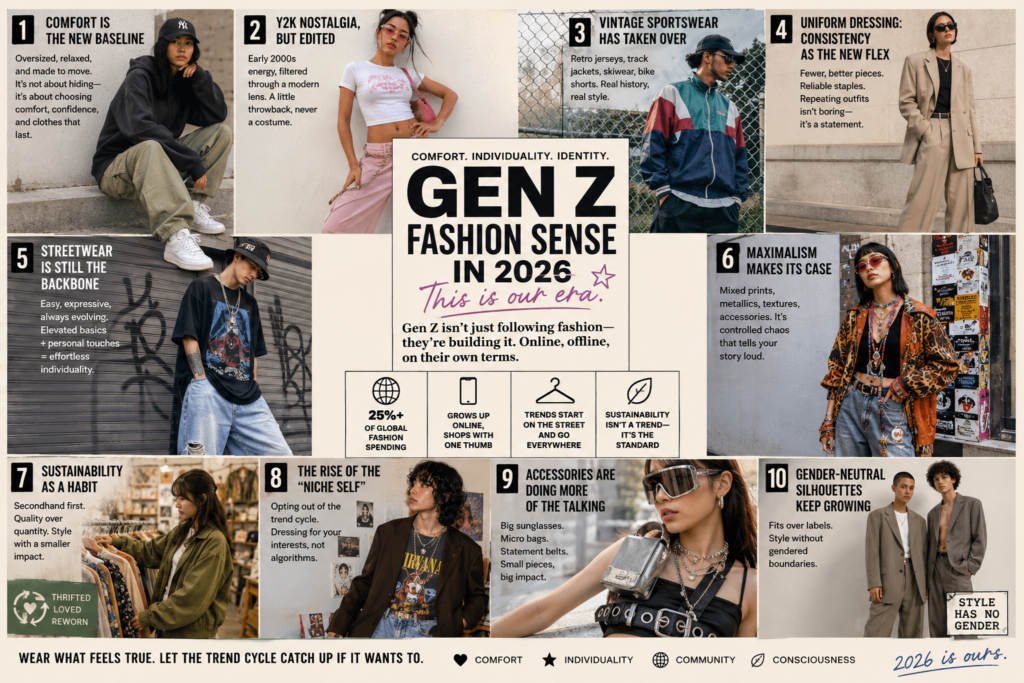
Gen Z Fashion Sense in 2026: Comfort, Nostalgia, and the Death of the Trend Cycle
Fashion used to trickle down from runways to the street. In 2026, it moves the other way. A thrifted jacket, a DIY patch, or a 10-second clip on a phone screen can spark a global style moment before any fashion house even sends its show notes to print. Nobody understands this better than Gen Z — the generation that grew up online, shops with one thumb, and now accounts for more than a quarter of global fashion spending. Their influence isn’t a side note in the industry anymore; it’s the main plot.
But what’s interesting about Gen Z fashion sense in 2026 isn’t just what they’re wearing — it’s why. This is the first generation raised entirely on the internet, with infinite access and infinite opinions available at a swipe. Underneath the filters, outfit reels, and shopping hauls is a search for identity, authenticity, and belonging. Clothing has become less about following a designer’s vision and more about telling a very specific, very personal story. Here’s a closer look at how that plays out on the ground.
1. Comfort Is the New Baseline, Not a Compromise
If there’s one throughline across every Gen Z wardrobe in 2026, it’s this: comfort is no longer negotiable. Skinny jeans and body-hugging silhouettes have given way to relaxed, oversized shapes that leave room to move and breathe. Baggy cargo pants have replaced skinny denim as the default bottom. Drop-shoulder hoodies, wide-leg utility joggers, and boxy tees dominate over anything fitted or restrictive.
This isn’t laziness — it’s a values shift. A generation that talks openly about mental health and boundaries has carried that same instinct into how it dresses. Oversized clothing is being described, half-jokingly, as a kind of “body armor” — practical, protective, and unbothered by anyone else’s idea of a flattering fit. Quality matters more here too. Instead of buying ten cheap T-shirts that fall apart after a few washes, many Gen Z shoppers are choosing fewer, sturdier pieces that can be worn for years, not seasons.
2. Y2K Nostalgia, But Heavily Edited
The early 2000s are unmistakably back, but Gen Z isn’t recreating the era wholesale — they’re editing it. Only the fun, wearable parts survive the trip from 2003 to 2026: low-rise references, baby tees, glossy fabrics, playful mini bags, and bold logo pieces. What’s disappeared is the head-to-toe costume approach. Instead, a single statement piece — a pair of cargo pants, a fitted top, one loud accessory — does the work that an entire throwback outfit used to do.
This nostalgia isn’t nostalgia for its own sake, either. Most of Gen Z didn’t live through the 2000s as adults; they’re borrowing the era’s energy — its brightness, its unapologetic maximalism — and filtering it through a much more restrained, modern styling sensibility. The result feels current rather than costumey, because it never gets trapped fully inside the decade it’s referencing.
3. Vintage Sportswear Has Quietly Taken Over
One of the more surprising undercurrents in 2026 is the sheer scale of the vintage sportswear revival. On resale platforms, searches for vintage athletic-brand pieces have spiked dramatically, alongside rising interest in upcycled sports jerseys, skiwear, and old-school bike shorts. This isn’t just an athleisure moment — it’s a specific hunger for archival sport pieces with real history behind them.
Styling-wise, this trend shows up in unexpected combinations: a retro track jacket worn with raw denim, or a striped rugby shirt paired with heeled sandals instead of sneakers. The appeal lies in contrast — mixing something sporty and worn-in with something more polished, so the outfit doesn’t read as “gym clothes” but as a deliberate style choice.
4. Uniform Dressing: Consistency as the New Flex
After years of fashion moving at meme speed — a trend might dominate for a week and vanish before it even reaches stores — a real fatigue has set in. Rather than chasing every fleeting aesthetic, a growing share of Gen Z is settling into a smaller, steadier rotation of dependable staples: sharp tailoring, boxy knits, neutral workwear-inspired basics.
This shift makes sense in context. Economic pressure, decision fatigue, and constant digital noise have made repetition feel less boring and more like relief. Wearing a version of the same well-made outfit on repeat isn’t a lack of style — in 2026, it’s being read as its own kind of taste statement. It says: I know exactly who I am, and I don’t need a new persona every week to prove it.
5. Streetwear Is Still the Backbone
Even as uniform dressing rises, streetwear hasn’t gone anywhere — it’s simply evolved into something more elevated. Oversized hoodies, graphic tees, chunky sneakers, and bucket hats remain a go-to formula because they’re easy to wear and endlessly personalizable. What’s changed is the finish: instead of chasing the loudest logo, Gen Z is now favoring “elevated basics” — pieces that look expensive and considered, even when the silhouette is dead simple.
A single thrifted piece, a custom graphic, or an unusual accessory is often all it takes to turn a basic streetwear outfit into something that feels personal instead of generic. This is streetwear’s real power in 2026: it’s flexible enough to hold both comfort and individuality at the same time.
6. Maximalism Makes Its Case
Not every corner of Gen Z style is about restraint. Running alongside quiet, uniform dressing is a fully maximalist streak — mixed prints, metallics, unexpected textures, and statement accessories stacked together so the look feels “collected,” not color-coordinated. It’s a controlled kind of chaos: deliberate clashing rather than an accident.
This is where Gen Z’s love of individuality shows up most clearly. A maximalist outfit is nearly impossible to replicate exactly, which is precisely the point. In a fashion landscape where everyone has access to the same viral pieces, standing out increasingly means combining things in a way nobody else would think to try.
7. Sustainability as a Habit, Not a Hashtag
Sustainability hasn’t disappeared from the conversation — if anything, it’s become more embedded and less performative. Rather than treating eco-friendly fashion as a marketing label to look for, many Gen Z shoppers have folded sustainability into how they buy by default: choosing secondhand first, favoring quality over quantity, and staying skeptical of brands that lean too hard on “green” messaging without backing it up.
Resale and thrifting platforms continue to grow because they solve two problems at once — they’re often cheaper, and they let people find pieces nobody else will be wearing at the same party. Buying fewer, better things has quietly become one of the most consistent Gen Z fashion habits of the year.
8. The Rise of the “Niche Self”
Perhaps the most defining shift in Gen Z fashion sense in 2026 is a rejection of the trend cycle altogether. Micro-trends now move so fast — one week it’s “office siren,” the next it’s some entirely different internet-coined aesthetic — that chasing them has started to feel pointless. In response, many are opting out, building wardrobes around personal interests and specific tastes rather than whatever is trending that day.
This has been described as the era of the “niche self” — a closet that reflects one person’s very particular combination of references, rather than a single viral aesthetic borrowed wholesale. Someone might mix a vintage band tee with tailored trousers and thrifted boots, not because it matches a named trend, but because it matches them. In a landscape saturated with sameness, that specificity has become the real currency of style.
9. Accessories Are Doing More of the Talking
If clothing itself has gotten simpler and boxier, accessories have picked up the slack. Oversized shield sunglasses, chunky micro-watches, archival mini bags, and carpenter-style belts worn purely for style rather than function are all showing up on Gen Z’s radar this year. These pieces tend to be small in scale but loud in presence — a single accessory can flip a plain outfit from forgettable to unmistakably “of the moment.”
What’s notable is how mismatched these accessories often are on purpose. A tiny lace tank might be paired with a pocketed work belt and studded capri pants — three references from three completely different style worlds, worn together without apology. This willingness to break unwritten style rules is very on-brand for a generation that has never been especially interested in dressing by a rulebook in the first place.
10. Gender-Neutral Silhouettes Keep Growing
Another quiet but steady shift is the continued blurring of traditionally gendered clothing categories. Oversized fits, unisex tailoring, and shared silhouettes between men’s and women’s collections aren’t treated as a novelty anymore — they’re simply how a large portion of Gen Z shops. A boxy blazer, a wide-leg trouser, or a drop-shoulder jacket is just as likely to be worn by someone regardless of how the brand originally labeled it.
This isn’t necessarily framed as a political statement by the people wearing it, even though it often gets discussed that way in the press. For many, it’s simply about fit, comfort, and personal taste taking priority over categories that feel increasingly beside the point.
What Ties It All Together
Look closely at these threads — comfort-driven silhouettes, edited nostalgia, vintage sportswear, quiet consistency, elevated streetwear, deliberate maximalism, sustainable habits, loud accessories, gender-fluid fits, and hyper-personal style — and a clear picture starts to form. Gen Z fashion sense in 2026 isn’t about one look or one label. It’s about clothing with a point of view: comfortable enough to live in, referential enough to feel familiar, and specific enough to feel like nobody else’s outfit but yours.
The old model, where a handful of designers dictated what was fashionable and everyone else followed a season later, doesn’t really apply anymore. Trends still exist, but they’re shorter-lived, more fragmented, and increasingly optional. What lasts is something less flashy but more durable: a generation that has learned to dress for comfort, for individuality, and for values that go beyond what’s simply popular this week.
Whether the mood on a given day leans sporty, polished, maximalist, or thrifted-and-quiet, the underlying message from Gen Z stays remarkably consistent — wear what feels true, and let the trend cycle catch up if it wants to.
Fashion moves fast, and what’s dominant one season can shift by the next. Keep an eye on resale platforms, street style, and shopping data for the freshest signals as the year goes on.